
Trusted by the world’s leading organizations







Transform to outperform in today’s rapidly evolving capital markets.
In the new era of capital markets, client needs are becoming more sophisticated and firms must surpass (not just meet) rising digital technology expectations to achieve a sustainable competitive advantage.
Our technology is uniquely capable of satisfying the market’s daunting data distribution needs in the areas of scale, security, and speed – all while handling unpredictable bursts of activity and enabling compliance with ever-shifting regulations.
We give all kinds of capital markets participants and service providers the ability to establish an event-driven foundation on which they can differentiate their business by reducing costs, more quickly seizing market opportunities by introducing innovative services, and better serving their customers.
Learn how one capital markets technology leader has succeeded with Solace technology for over a decade.
I don't know of any other system where, if I threw an extra 20 or 30 billion messages at it, without adding anything, without having to change anything, it would just cope... It's definitely paying for itself."
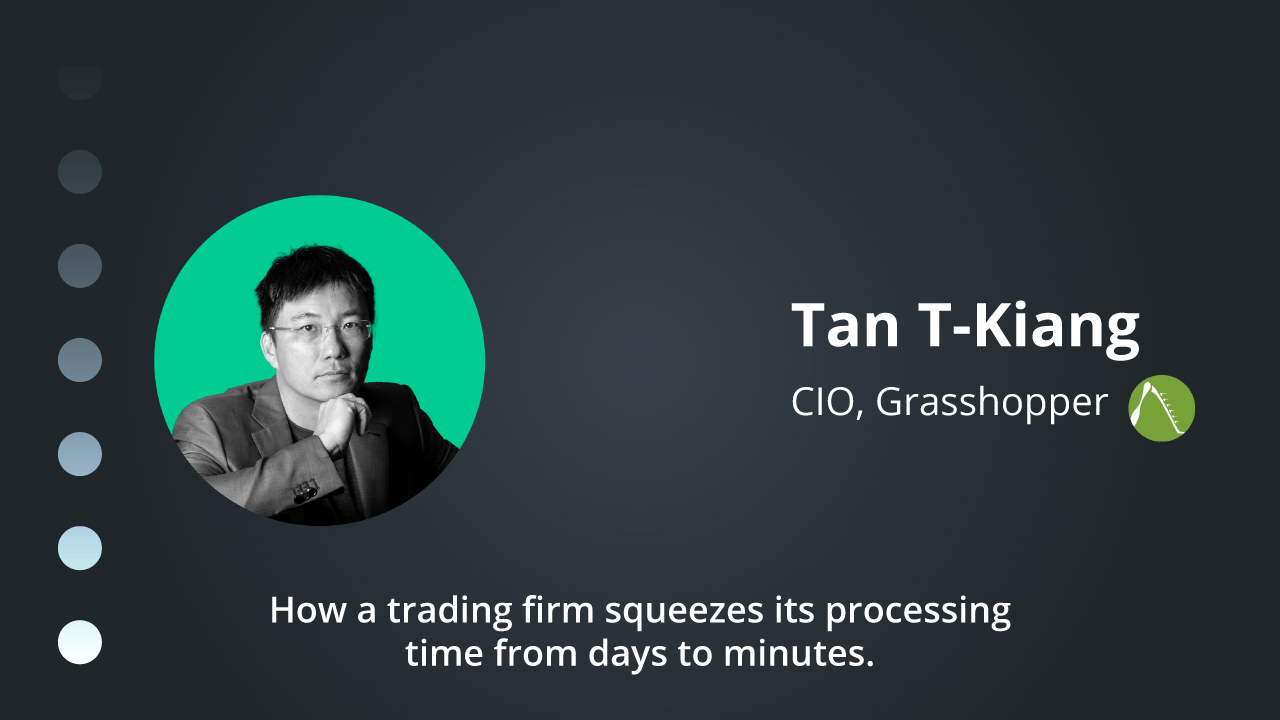
Grasshopper, a liquidity providing firm, built an event mesh to leverage cloud-native AI/ML services.
Solace is allowing us to better compete in the next decade with a fully flexible, state-of-the-art infrastructure.
How we help capital markets participants thrive in this age of extreme volatility and regulatory pressure
Market Data Distribution
Solace enables the efficient distribution of low latency market data to the systems and people that need it and are authorized to receive it. With support for fan-out and other data distribution patterns, and integration with leading platforms and standards like kdb+ and OneTick, Solace makes market data distribution easy, fast and secure.
Next-Generation User Experience
By aggregating data across asset classes and presenting it to users via intuitive web and mobile app interfaces, sell-side firms can give their clients unprecedented visibility into complex opportunities for profitable trades. Solace enables a single dealer platform (SDP) for unified delivery of pricing, risk and liquidity information by performing low-latency quote distribution, guaranteed order flow, and real-time streaming to mobile and web applications. In addition, PubSub+ integration with tools like OpenFin helps businesses better support their distributed workforce.